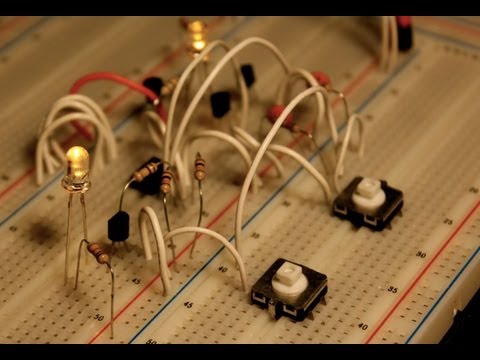
1 How Shift Registers Work!
A clear explanation of how a 74HC595 shift register works and how to drive many LEDs from a few Arduino pins.
Channel
10 recommended videos. Channel on YouTube
A clear explanation of how a 74HC595 shift register works and how to drive many LEDs from a few Arduino pins.
Explains how a shift register can scan many buttons or inputs from a handful of Arduino pins, sometimes linked alongside the same creator's output video.
Shows how to put an ATmega328 into deep sleep and wake it with interrupts or the watchdog, reaching microamp currents on a bare chip.
Shows an Arduino cutting its own power through a transistor after a button press, offered as an example for battery projects that need near-zero standby current.
Walks through several cheap ways to shift logic between 5 V and 3.3 V and compares how each holds up as frequency rises.
Praised as a visual walk-through of the I2C protocol, driving the bus by hand so each clock and data transition can be seen.
Cited for showing how to drive WS2812 style addressable LEDs directly from a microcontroller without relying on a library.
Shared as a practical explanation of driving LEDs at constant current with a shunt regulator and a transistor instead of a resistor per LED.
Demonstrates using the TLC5940 multi-channel PWM driver with an Arduino to run many RGB LEDs, suggested whenever someone needs more PWM outputs.
Offered a few times as an explanation of the low-level encoding behind basic radio modules, though commenters recall it only loosely.